Thursday, February 16, 2012

The Great-Ness

Three Decades in the Making


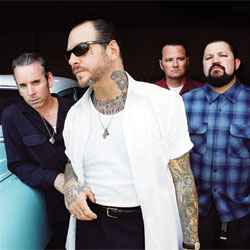
Social Distortion’s Mike Ness and Jonny 2 Bags talk about love and loss, music and fans, addictions and parenthood—the ups and downs of the seminal punk band that brought them together


IE Weekly
 
When a 21-year-old Mike Ness rolled up to his friend’s half pipe, 16-year-old Jonny Wickersham had no idea he was looking at his future sitting on a stolen 10-speed. 
The lead singer of then up-and-coming punk band Social Distortion who was five years Wickersham’s senior already had the sort of cult of personality that announced his presence—even from behind a spray painted black bicycle with flipped-up, handle bars. 
The two young men, who lived a block away from one another in the Costa Mesa apartment clusters, bonded over their love of punk rock music, skateboarding and general disenchantment with the world.

Wickersham and his friends had recently witnessed Ness and company’s performance in Pomona. “He thought of me more like a kid coming around, like super fandom,” Wickersham says. As he got older though, the two became peers in the music business, their Orange County-based bands sharing stages and fans.

Wickersham, now known as punk rock guitarist Jonny 2 Bags—who has done time in Cadillac Tramps, Youth Brigade and U.S. Bombs—took over as guitarist for Ness’ wildly popular, three decades-old punk rock institution. He got the job after Ness’ friend and band co-founder, Dennis Danell, died on Feb. 29, 2000, from a brain aneurysm. 
More recently, Wickersham and Ness are in the midst of more than a year of touring to promote the band’s most successful album to date, 2011’s Hard Times and Nursery Rhymes. Social Distortion stops in at the Fox Theater in Pomona Friday and Saturday, February 17 and 18. 


Somewhere Between Heaven and Hell
Hard Times and Nursery Rhymes premiered on the Billboard charts at No. 4, securing the band’s immediate future on the road. The Ness-produced album, Social Distortion’s seventh studio recording four years in the making, is the band’s first Top 10 showing. 
“I guess it was a critic’s record,” Ness says. “To get this kind of recognition this late in the game is great.” The record’s success is due in part to the chemistry between Ness and Wickersham, who share songwriting duties on many of the tracks. Bassist Brent Harding and drummer David Hidalgo Jr. currently round out the lineup.

Danell’s death put the band’s future in question for many. Danell’s footprint on the band was so huge, it meant very big shoes to fill, Wickersham says.

“Although I wanted to do it, and I wanted to play in the band, it was such horrible circumstances,” Wickersham says looking back. He himself a big fan and close friend of Danell. “Like I was an imposter.”

Despite having filled in for Danell in 1997 for part of the band’s European tour, Wickersham’s next gig with Ness was possibly his most somber: a benefit for Danell’s family at the former Irvine Meadows Amphitheater, now the Verizon Wireless Amphitheater. Danell’s wife, Christy, helped ease the load Wickersham carried.

“When she got there, she walked up to me and said, ‘You must really feel like you have the weight of the world on your shoulders today,’” Wickersham recalls. “I mean, she’s grieving, and I couldn’t believe she thought about how I would be feeling. That made me feel a lot better.” 

A New Era
Not long after, Ness asked Wickersham to join the band full time, and a new working relationship was born, as well as a new era for Social Distortion. The two immediately collaborated lyrically, a role in the band Ness rarely shared with his oft-rotating players. Danell had been the only constant besides Ness, and one of the few to share songwriting duties with the band’s front man.

“It felt really great,” Wickersham says about the confidence Ness showed. The two started writing together for what turned into 2004’s Sex, Love and Rock ‘n’ Roll.  “The chemistry in that sense was really strong at that time.” 
Ness had plenty of confidence in Wickersham. “He’s a guitar player, and he grew up listening to this band,” Ness says. “We had chemistry. It’s a rare thing. Some artists can collaborate with just anybody. For me there has to be that level of comfort, trust and respect.”

The two grew up in similar situations, hailing from broken homes and finding solace in punk rock. “We understand each other,” Ness says, adding that their long history together helped cement the bond. 


Punk Lives On
A decade later and the band shows no sign of slowing down; its audience continuing to grow. With the support of its new label, Epitaph Records, Ness opened up to trying new things to reach a bigger audience, confident in the label’s authenticity while flirting with mainstream success.

“We kind of always had the mindset that there are hundreds of thousands of Social Distortion fans who don’t know it yet,” Ness say. After years of keeping a stronghold on the Southern California scene, and remaining a go-to guy for punkers of all varieties, he’s finally breaking through, becoming genuinely famous in other circles.

“When there is someone who I have a relationship with outside of work that is not a typical candidate to be a fan, or they read about it and got the record and they really like it, that’s always cool to me,” Ness says. “Even back in the day, I didn’t only want to play in front of punk rockers. I wanted to get all kinds of people to hear it.”

Ness and the band performed on television for the first time, hitting Jimmy Kimmell Live! last year. Ness also wrote and starred in a conceptual short film for the album’s first single, “Machine Gun Blues.” 

The song strayed from Ness’ tried and true songwriting routine, as he set out to break from writing purely down-on-his-luck autobiographical songs. “I got back into character writing,” Ness says, citing “Gimme the Sweet and Lowdown” as another example. The song portrays someone giving advice to another who is hitting rock bottom.

“That could be about me, or some of my friends, but I wanted to remove myself from the song even though I am still sort of writing about myself,” Ness says. “I didn’t want to fall into any one style of writing. You just don’t want to get stuck. I wanted heavy, I wanted fiction, nonfiction, I wanted slow and I wanted fast. I was basically going back to how I was writing a song back in 1980, when I wrote ‘1945.’”

“Machine Gun Blues” tells the tale of a machine gun-toting, Roaring ’20s gangster in over his head. “It’s the not-so-glamorous side of gangster life,” Ness says. “He genuinely feels remorse, things just got out of control. He’s not a psychopath.”

If that song was about Ness in an abstract way, one might read into it some repentance for past mistakes. Ness famously struggled with heroin addiction in his early years, followed by jail time and rehab to get his mind straight before releasing the band’s second album, 1988’s Prison Bound, the follow up to 1983’s Mommy’s Little Monster.

Prison Bound signaled a crossroads for the band, leaning equally on Johnny Cash and Exile on Main Street-era Rolling Stones. By 1990, the eponymous album Social Distortion went gold, producing the band’s trademark singles “Story of My Life” and “Ball and Chain,” making Ness a bona fide rockabilly and punk rock icon.

The next two albums, 1992’s Somewhere Between Heaven and Hell and 1996’s White Heat, White Trash kept the band touring steadily. 

From Mommy’s Little Monster to Nursery Rhymes
Social Distortion never really required a new album to draw crowds, particularly in Southern California.

“Social Distortion is a good example of a band that has really stayed true to the sound,” Wickersham says. “Mike likes to evolve from record to record but he doesn’t want to completely change the sound of the band. He ignores trends.”

The band consistently sells out House of Blues clubs for weeks at a time—the fans’ enthusiasm always reminding the band of its relevance between releases, motivating them to get back to writing songs.

“I don’t care what anyone says, no matter how hot your band is, 50 percent of the show is the crowd,” Ness says. “When you have that kind of reaction, it inspires you to go in and do something to support that. We definitely feed off of that.”

Each time Ness returns to the studio, he’s armed with an arsenal of songs chronicling his life, a sort of portrait of where he’s at emotionally. No longer mommy’s little monster, he’s more your typical dad in many respects, one who pays the bills with a vintage Gibson and a tour bus. With that comes some grown up angst to boot.

His sons, 20-year-old Julian and 16-year-old Johnny, along with his wife, Christine, help keep Ness grounded and content. Julian, who has joined his father on stage occasionally, is headed for the family biz.

“Julian is the younger version of me,” Ness says. “We cause each other anxiety because of that. Our relationship has gone through a lot of ups and downs. But it’s in a good place.”

The song “Writing on the Wall” was inspired by Ness’ experience on the other side of drug abuse, as a father wondering if his son is lost in the perils of addiction.

“To have made it through that and be on the other side of it right now, it’s just so nice to not have to worry about that,” Ness says. “You still worry if they are going to be able to work and support themselves, but to not have to worry about his safety is so nice.” 
Julian is making his father proud these days, playing guitar in the Orange County band the Breakdowns. The band recently opened for the Cadillac Tramps at the Tiki Bar in Costa Mesa.

Other songs, like “Diamond in the Rough” give a glimpse of a happier, well adjusted Ness looking at a wide-open future as he sings “I’ve got a reason to live another day.” 
“Through the years I’ve learned to get inspiration from the positive things in my life as well, not just the dark, negative, painful stuff,” says Ness, who famously has the words “Love” and “Pain” tattooed on his knuckles. “I think it’s important to balance it . . .  I am different person than I was in 1995. I am older. I am hopefully more mature, and hopefully a little wiser.”

These days, Ness is nearing 50, living on the Newport Beach Peninsula, staying fit through a vegetarian diet and boxing in the ring with Julian. Life is sweet, something a listen to Hard Times and Nursery Rhymes reveals. He remains grounded.

“I think that Social D has gotten successful very slowly over the last 33 years,” Ness reflects. “Our level of success has been very gradual and very organic, a slow upward movement. It helps you appreciate the success a little more, and it helps you keep it kind of real.”

Social Distortion with Frank Turner and the Sleeping Souls, Sharks at the Fox Theater, 301 S. Garey Ave., Pomona, (909) 865-3802; www.foxpomona.com. Fri-Sat, Feb. 17-18. 8PM. $35.

To link to the original story, click here: 

Sunday, February 12, 2012

Funny Lady Alert

Family Ties

IE Weekly

Polly Frost shares the love, loss and laughter that comes only from those closest to you

 
Writer Polly Frost mostly sits around in dirty pajamas tickling funny bones through her keyboard, but her family thinks she spends her days frequenting kinky orgies. “If you ever want your family to think you are goofing off, try writing erotica,” she says with an extended laugh.

The New York City-based humorist has been published in The New Yorker and The Atlantic, written numerous plays with her husband Ray Sawhill, and published a humor book, With One Eye Open. But it’s the smut the brood dwells on, the horror-driven and sci-fi erotica that will always make up the cannon of her work in their esteem.

Family. You’ve got to love ’em, but that doesn’t mean you can’t laugh at their expense to keep your own sanity. Frost, who has been called the Edith Wharton of her generation by Elle magazine, visits the Winery at Canyon Crest in Riverside Sunday, Feb. 12, with her one-woman show, “How to Survive Your Adult Relationship with Your Family.”

Despite her happy childhood growing up in Southern California, Frost knows that functional childhoods be damned, we all grow into adults whose relationships with our ever-evolving families present challenges.

“It’s about all the ways your family can change and how they view you,” Frost says. It’s the extended-blended-hyper family that presents the most material. Frost’s family has an average of three marriages per relative. Even her grandparents, who divorced in their 80s over hitting up the cruise line circuit, add to the absurdity.


“How do you deal with all these crazy relationships thrown at you?” Frost says. Relationships with family members stay very much the same to where you never outgrow your role in the dynamic, or it changes so drastically that you barely recognize one another. Or worse.

“One of the big things is when people you love marry people you hate, those toxic in-laws,” Frost says. “What difference does it make if you had or didn’t have a happy childhood if you have this toxic in-law coming into your family and wreaking havoc?”

And the blended family Thanksgiving with all the exes? “It doesn’t work for me,” Frost says. “I think it’s a massive recipe for indigestion.”

Frost wrote the show after her brother died of Parkinson’s disease two and a half years ago. The cancer surgeon who was struck by a disease that made it impossible for him to carry out his career never lost his sense of humor, Frost says.

The mourning process came with so many insights into the human spirit, good and bad, that Frost began jotting them down. The best therapy, she found, was a hearty chortle and connecting with an audience that could relate.

“With this show I did not want to do stand-up comedy,” Frost says. “People who come to the show laugh, they cry, and thank goodness they laugh again. I wanted to hit a full emotional range.”

Six months later, the show continues to evolve, Frost says. “I was able to face things I couldn’t face at first because I couldn’t talk about them,” she says. “It took a few months before I could face down and talks about some of the things in my family.” The hardest moments to talk about are the ones that resonate the most.

“People come up to me and talk about their experiences,” Frost says. “That’s when you know it’s working for them.” That connection is inspiring, and helps her ditch the jammies and get on stage.

 “There is a real tradition of that; Mark Twain wanted to do that at a point in his life, so did Dickens,” Frost says. “I think maybe we are coming back to that, maybe the Internet, it’s fantastic, but I feel that with all of this we need to establish that connection that is very direct with audiences and that is what this show is about for me.” It’s a family-friendly, smut-free affair.

Polly Frost performs “How To Survive Your Adult Relationship with Your Family” at Winery at The Canyon Crest, Canyon Crest Towne Centre, 5225 Canyon Crest Dr., Ste. 7A, Riverside, (951) 369-WINE; www.canyoncrestwinery.com. Sun, Feb. 12, 7PM.

Original link to the story in IE Weekly:

Thursday, December 22, 2011

This Ain't No Crazy Cat Lady

Tracy Shedd’s relationship may have leaked into her writing, but she keeps the cat stories to herself

By Arrissia Owen
IE Weekly

Tracy Shedd couldn’t help but follow in her mother’s footsteps. Growing up in Jacksonville, Fla., the country singer’s daughter went on to become a performer as well, cutting her chops crooning along with Patsy Cline songs like “Crazy” on her family’s living room PA system.

It could be because one of Shedd’s most vivid memories from her childhood was seeing her mother performing in Mayport, all decked out in cowboy hat, boots and fringed jacket.

“I remember thinking, ‘I have a cool mom,’” Shedd says, now a touring musician based out of Tucson, Ariz., where she lives with her lead guitarist/husband James Tritten. She visits Palm Springs Friday, Dec. 23, to perform at the Ace Hotel.

That sort of musical influence in Shedd’s life led to an early start on her musical path, starting with classical piano lessons. At age 6, she composed her own takes on Bach and Beethoven.

But while she was in high school, Shedd’s parents divorced. The baby grand piano went to her mother in the divorce, where Shedd lived part-time. The rest of the time she resorted to a cheaper version of keys.

That led to Shedd picking up the guitar, and by her senior year stepping up to share lead vocals in her high school band, Sella. She was able to utilize her skills on the 88s in the ’80s for that band, taking on Moog and analog synths.

“I guess I just stopped because a keyboard never really satisfied me the same as the grand piano,” Shedd says looking back.

After moving to Arizona and embarking on a career as a singer-songwriter-guitar player, Shedd returned to her first love. The local radio station KXCI FM asked Shedd to join its Winter Solstice radio broadcast. But because she is self-taught on guitar, Shedd didn’t feel comfortable reading music for traditional Christmas carols. But she did know how to read music on that other instrument.

“I thought, ‘Why not try and learn the Christmas songs on piano?’” Shedd recalls. She went out and purchased an electric piano and got to jingling. “To my surprise, everything came back pretty quickly and I immediately started writing songs. It has been a treat to have two instruments to write on.” 
With her new instrument at her fingertips, Shedd composed the songs on piano for her most recent release, the aptly titled EP88, the follow up to 2008’s Cigarettes & Smoke Machines. The songs exhibit fuller, admittedly moodier compositions. She combines her folky medium with shoegaze influences, bands like My Bloody Valentine, Cocteau Twins and other ’80s Manchester acts.


“Writing EP88 was definitely by default different than any of my other records being that it was written on piano,” Shedd says. “It’s way more somber. It’s funny, now I’m ready to pop it out again on guitar when we get back to Tucson.”

Joining her on the recordings is her husband, James, who has played on four of Shedd’s albums since 1991, starting out on drums and adding lead guitar for the last three. Inevitably, their relationship finds its way into the songs, too.

“The songs seem to write themselves,” she says. “I definitely pull from personal experience: dreams, life, et cetera. The only thing off limits would be my cat, Kickflip. She has asked me not to include her in my songs. She prefers to keep her personal life out of the public eye.” 
Besides, writing a song about her cat, well, now that would just be crazy. 

Tracy Shedd performs with Young Mothers and JP Houston at the Ace Hotel, Amigo Room, 701 E. Palm Canyon Dr., Palm Springs, (760) 325-9900; www.acehotel.com. Fri, Dec. 23. 9 PM. Free. 21+.

Link to the original story in IE Weekly:

Friday, December 9, 2011

Murphy's Law

The happiest goth in the world...

"Howdy doody."   

"Hello. May I please speak to Peter Murphy?" 

"This is he." 

Howdy doody? Every ounce of nervousness that built as I prepared to call Murphy melted. Turns out the former Bauhaus frontman isn't as intimidating as I expected. We chatted about the difference between American, European and British fans, and about the Catskill Mountains in New York, He he hopes to buy a home in Woodstock one day,splitting his time between Turkey, where he has lived with wife, Beyhan, since the early ’90s. 

Beyhan, artistic director for Turkey’s National Contemporary Dance Company, is a kindred spirit for the lithe, lyrical lothario, whose music has shown much Middle Eastern influence over the years. An admirer of legendary choreographer Lyndsay Kemp and Ziggy Stardust-era David Bowie, it was no surprise Murphy would fall for a dancer. But still, he insists the whole feel of his show is organic, nothing contrived.

“I am not a corporate Madonna type,” the self-proclaimed rock ‘n roll outsider says. “My performances are all real. It’s not staged, not silly experimental choreography just to make it look good … I love to be on stage and create something out of that with a musical element. ” 

Here is an awesome video from the 2006 Radio Sessions, a version of "Bela Lugosi's Dead" with Trent Reznor and TV On the Radio. It's awesome:

http://www.youtube.com/watch?v=n8W4tslqVSg

Here's the story I wrote for IE Weekly based on the interview:

The Hunger Lives On


Peter Murphy’s career extends well beyond his Bauhaus days

Peter Murphy always knew he would live forever. Not in an undead, Twilight sort of way, but through song.

The former Bauhaus frontman’s career spans more than four decades, kicked off with the unlikely hit, 1979’s “Bela Lugosi’s Dead.” The single cemented Murphy’s role as the godfather of Goth subculture. The song is not dying off anytime soon.

“I was completely certain from the moment I started writing songs that it was meant to be,” Murphy says, putting all English humility aside. “I heard Bob Dylan say once that there was no use in working toward anything unless you believed in it. It’s almost like when you have a sense of destiny. It’s a journey where you are discovering that.”

Now in his 50s, Murphy shows no signs of slowing down with a new generation discovering his influential role in the genre. From 2006 through 2009, Murphy toured and recorded with Trent Reznor often. TV on the Radio and others joined Murphy and Reznor to record the cultish 2006 Radio Sessions, reinterpreting one another’s songs as well as those by bands that influenced the superstars.

Murphy’s journey began in Northhampton, England, with Bauhaus bandmates Daniel Ash, David J and Kevin Haskins. The four friends cultivated a new sound that gave life to an inspired gloomy groove.

The band performed “Bela Lugosi’s Dead” during the opening scene of the 1983 vampire film The Hunger, starring David Bowie and Catherine Deneuve, raising the band’s profile exponentially. But that same year, the group imploded due to infighting, launching Murphy’s solo career.

After a brief project with Mick Karn of the band Japan, Murphy recorded a string of albums, including Deep, which produced probably his most recognizable alt-rock solo single, “Cuts You Up.”

But even with an impressive catalog of solo work, fans continually yearned for Bauhaus reunions. The band gave in a few times over the years, most famously at Coachella in 2005 and during a tour with Nine Inch Nails in 2006.

That Bauhaus reunion resulted in the 2008 release Go Away White, but also the band’s second acrimonious demise. On Murphy’s most recent album, Ninth, “I Spit Roses” responds to the kerfuffle.

“The song recognizes an end, but it’s not sad,” Murphy says. “It’s like, ‘Thank God for that.’ I’m free of it.” Murphy says it’s a joyous song, no mourning going on at all about the Bauhaus split. “Why would you mourn something that was such a miserable collective experience after all? It’s my version of the Elton John song ‘I’m Still Standing.’ It’s like saying, ‘I’m fine, darling, come and see me.’”

These days, Murphy is more than OK, fresh off a European tour, skipping around America performing new songs off the David Baron produced album. Murphy recorded solely in the artist-enriched Woodstock, N.Y. area.

While writing and recording Ninth, he made a clear distinction between two types of compositions emerging. Ninth became home to the more radio-friendly single types.
Murphy held onto the others, resulting in the new EP Secret Bees of Ninth. “I wanted them to have a more direct, sledgehammer-like effect,” Murphy says. “For Ninth, I didn’t want to trail off into opus, more esoteric pieces.”

The release harkens back to the baritone’s Bauhaus days, as does an auspicious reminder of the singer’s reach. Murphy had a blink-and-you miss it moment in 2010’s The Twilight Saga: Eclipse as the vampire named The Cold One.

“That was me playing myself really,” Murphy jokes. But the quick cameo didn’t quite catapult him into tween notoriety. “It was really a wry, kind of wink to those who know . . .  It’s sort of a bookend to The Hunger.” As well as proof that Murphy’s career is very much alive.

Peter Murphy with She Wants Revenge and Hussie Club at The Glass House, 200 W. Second St., Pomona, (909) 865-3802. Fri, Dec. 9. 7PM. $25.

Thursday, September 15, 2011

World of Warlocks

This Ain't Grateful Dead or The Velvet Underground 

IE Weekly

The Warlocks, a band unto itself, brings a different brand of psychedelia to the annual Clean Air, Clear Stars fest

 
Growing up with a grandfather who owned a radio station and a mother who helped run the place, Bobby Hecksher couldn’t help but soak up the sounds of classic rock bands like The Beatles and The Rolling Stones. Surrounded by little else than alligator marshland, it was a welcome distraction for the Florida youngster.

But it was when Hecksher—who would go on to become frontman for psychedelic rockers The Warlocks—discovered punk rock, that his musical maelstrom began to evolve. He tumbled toward bands like the Butthole Surfers, the Minutemen, The Flaming Lips and Sonic Youth during middle school. Things started to click.

“When I heard those bands, I felt like I finally woke up,” says Hecksher, whose The Warlocks perform at the fifth annual Clean Air, Clear Stars Global Cooling Festival Sept. 23 to 24 at Pappy & Harriett’s near Joshua Tree. “I was gravitating toward that sort of music that had more song structure and was leading toward the psychedelic sound. It was raw and cool.”


Fortuitously, Hecksher’s parents packed up and moved to L.A. by his teen years. It was the 1990s and grunge was de rigueur, but he continually found himself drawn to the more experimental side of West Los Angeles’ music scene. One of his earliest gigs was as bassist on Beck’s Stereopathetic Soulmanure in 1994. That led to his time with performance art-rock ensemble Don Knotts Overdrive before joining the Brian Jonestown Massacre, adding guitar and bass on 2001’s Bravery, Repetition and Noise.

Brian Jonestown Massacre’s singer Anton Newcombe was instrumental in Hecksher’s transition to frontman status. “He was a bit of a maniac,” Hecksher says, reaffirming an already raucous reputation. “But when you got down deep and hung out with him, you realized he was really talented and very encouraging.”

It was Newcombe who helped instill in Hecksher the confidence to do his own thing, which inevitably led to his departure from the band for his own gig. “He was very different from a lot of the people I played with,” Hecksher says. Leaving was bittersweet.
“I had always considered myself a bass player up to then. From there I started writing and The Warlocks started from that.”

Hecksher was blissfully unaware of the little known pedigree that went with his new band’s name. “People think I had this huge thing about it, like I knew it was part of the Grateful Dead and The Velvet Underground’s past,” he says. “But back then, I really didn’t know that these other bands had been called The Warlocks briefly before.” 
The name just sounded cool, he says. It had teeth and grit. “I always liked the way it sounded and the imagery fit what we were doing—it’s gloomy, dark and psychedelic,” Hecksher says.

The Warlocks are five albums deep into a career that has weathered various band members and three labels. The current lineup—Hecksher, guitarists JC Reese and Earl Miller, bassist Chris DiPino and drummer George Serrano—is on San Diego-based label Cargo Records. Its most recent release, 2010’s Rise and Fall: EP and Rarities, is a collection showcasing the band’s decade-strong feedback-fueled noise rock.

The label, which boasts a large roster that includes Brian Jonestown Massacre, The Pains of Being Pure at Heart and more, has a huge presence overseas, building on The Warlocks’ European fan base cemented during its time on Mute Records.

“We’re like The Beatles in France,” Hecksher jokes, as befuddled as anyone. “I asked some French fans to explain it to me once, and they just kind of said that it’s the way the words translate to them.” 

The Warlocks perform with Adam Franklin and Bolts of Melody, the Black Ryder, Icarus Line and more at Pappy and Harriett’s Pioneertown Palace, 53688 Pioneertown Road, Pioneertown, (760) 365-5956; www.cleanairclearstars.com. $20-$30.

Stephen Tobolowsky's got character

Groundhogged for life

 Big Bear Grizzly

Actor Stephen Tobolowsky will be honored for lifetime achievement at local film fest

September 14, 2011 5:00 am


The monsters swayed Stephen Tobolowsky. As a little boy, he dreamed of becoming a professional actor so he could meet Frankenstein, Godzilla and the Wolfman.

“I thought Godzilla would be able to show me how to breathe fire,” says Tobolowsky, now a seasoned character actor with more than 150 films, a Tony award and numerous TV spots to his credit.

As he grew older, Tobolowsky kept the dream alive with a twist. “I thought actors sailed ships across the ocean, got to fight wars,” he says with a slight chuckle. “But, actors have no adventures. We sit in trailers, play Tetris, have lots of down time. The stuntmen see all the action.”

"Deadwood"


Tobolowsky does have plenty of life experience, culminating in 2005’s “Stephen Tobolowsky’s Birthday Party,” a film that shows him recollecting real life while preparing for his own birthday party. The idea since sparked a podcast series and an upcoming book published by Simon & Schuster.


On Sept. 16, the man you may or may not recognize from his character actor CV receives the lifetime achievement award for acting at the Big Bear Lake International Film Festival’s opening night gala.
Tobolowsky has a knack for bringing eccentric everymen to life on the screen—he was Ned Ryerson, Bill Murray’s former classmate turned insurance salesman in “Groundhog Day” and Sammy Jankis in “Memento.” Depending on your demographic, you may know him from recurring roles on “Deadwood,” “Californication,” “Heroes” or “Glee.”

“People often recognize me, but they don’t know who I am,” Tobolowsky says, taking his low-key fame in stride. “Or they think I used to work with their dad.”

As Ned Ryerson


The balding, bespectacled 60-year-old didn’t set out to become a character actor. The designation is assigned at moments that hardly appeal to one’s vanity. For Tobolowsky, it was after finishing a production of Tom Stoppard’s “Jumpers” in 1975.

Tobolowsky was playing an 85-year-old man. His hair, sprayed with streaks of gray, fell out in clumps upon a strenuous wash. “From then on, the romantic lead was pretty much out of the question,” he says.

Determined to stick with his art, Tobolowsky found his niche, taking to small roles and making them memorable. “As a character actor, you often play parts that don’t even have names,” he says. “But at the same time, you need to make them complete.” There is a backstory to every one, he says.
Developing stories comes naturally for Tobolowsky—he won a storytelling contest as a sixth-grader and held a reputation as a “fabulous” liar as a child—which lent itself to the evolution of “Birthday Party.”

Romantic lead days


The film opened to rave reviews at the HBO Comedy Festival in Aspen, South by Southwest and more. That led to a regular series of syndicated podcasts through slashfilm.com, “The Tobolowsky Files.”

Truth is often as entertaining as fiction, Tobolowsky has learned, and you don’t need creative editing for a clever ending, just time. Tobolowsky thought the one about the day he found out he was going to be a father was finished for years.

On location, alone, with no one to share the experience other than the hotel maid and bartender, Tobolowsky ran into an acquaintance, a stuntman, at the hotel restaurant. Over eggs, he shared the exciting news. The man said, “Well, things will never be the same for you ever again.”
Fourteen years later, Tobolowsky and his wife were at a sushi restaurant 2,000 miles away from that hotel when he felt a tap on his shoulder. It was the stuntman, teary eyed.

“I’ve been looking for someone to tell,” the man said to Tobolowsky. “My child just died, my firstborn. I knew I could tell you, because you would understand.”

The truth is as powerful as fiction, Tobolowsky says. “Sometimes it just takes longer to reveal itself fully.” It could even take a lifetime.

Contact reporter Arrissia Owen at 909-866-3456, ext. 142 or by email at aowen.grizzly@gmail.com.

For the original link to this story, click here:  http://www.bigbeargrizzly.net/outlook/arts_and_entertainment/article_cb1cbad4-dda5-11e0-a693-001cc4c03286.html

Friday, August 5, 2011

Swamp Funk Siren


As young music lovers in the early 1970s, Muldaur and friends would find random, scratchy recording and eat them up, hungry for more. When I interviewed her for a recent story, she talked about early 20th-century blues singer Victoria Spivey turning her on to female blues guitarist and singer Memphis Minnie, who Muldaur calls one of the “grandmamas of rock.”

Minnie was one of the first blues musicians to go electric. As Muldaur and Spivey searched for more of Minnie’s hundreds of recordings, it was by random luck that they came across anything. This was pre-Internet, when people relied on dusty record stores and music lovers to salvage the divine. Young people today discovering American roots music have an advantage, she says, which helps the genre persevere and create a resurgence.

“Now with the click of a mouse, you can download everything of hers in five minutes,” Muldaur says. “It’s a revolution.”

In 2008, Maria recorded “Yes We Can!” showcasing the work of some of the most socially conscious songwriters of the past half-century, including Dylan, Marvin Gaye, Allen Toussaint and more. The Women’s Voices for Peace Choir join Maria on the recording, along with Bonnie Raitt, Joan Baez, Jane Fonda, Phoebe Snow and others.

Talking to Muldaur was like opening a roots music history book. Here's a story I wrote for Big Bear Grizzly to promote her performance at the upcoming Blues for the Zoo fundraiser.

Blues for the Zoo featuring the Chicago Blues Guitar Shootout!, Maria Muldaur and her Red Hot Bluesiana Band and Brother Yusef is Aug. 6, 3 to 7:30 p.m. Gates open at 1 p.m. The Swim Beach Outdoor Amphitheater is at 41220 Park Ave., Big Bear Lake. Tickets are $30 in advance, $35 the day of the show. Children 10 and under are admitted free. Parking is $3. For tickets, call 909-866-4607 or visit www.moonridgezoo.org/concert. Food is available on site, no coolers are allowed.

Roots run deep for Maria Muldaur
Maria Muldaur

July 27, 2011

Big Bear Grizzly 

Maria Muldaur’s newest New Orleans-inspired album is full of “straight-ahead swamp funk,” the singer says. “It’s funky to the bone.”

Known as the “first lady of American roots music,” Muldaur heads to Big Bear for the Aug. 6 Blues for the Zoo concert. Known for her 1970s hits “Midnight at the Oasis” and her version of Peggy Lee’s “I’m a Woman,” Muldaur debuts songs from her upcoming September release “Steady Love,” with her band Maria Muldaur and her Red Hot Bluesiana Band for the Alpine audience.

Muldaur, nominated for at least six Grammys during her wide-spanning career, grew up in Greenwich Village, N.Y. Muldaur’s interest in music evolved into an affinity for American roots music, which she says was often marginalized back then by “above ground” radio and media, yet has continued to proliferate and grow. “It’s music of the people, by the people, for the people,” she says.

A younger, juggier Maria


As a young woman, Muldaur joined local jam sessions and song swaps. She soon took up with The Friends of Old Timey Music, a group that traveled to the rural South to find legendary artists like Doc Watson, Bukka White, Mississippi John Hurt and others to convince them to travel north to perform. She was part of a new wave of aspiring young musicians including the Lovin’ Spoonful’s John Sebastian, Bob Dylan, John Hammond Jr. and others.

Fiddle took hold of Muldaur, prompting her to leave the bright lights and big city behind for extended trips to North Carolina to study strings. At 19, she spent time with the famed Watson family, soaking up Appalachian music and culture. After returning to New York, Muldaur was asked by Sebastian, David Grisman and others to join the Even Dozen Jug Band.

Muldaur later moved to Boston and joined the Jim Kweskin Jug Band, recording “I’m a Woman,” the feminist anthem she continues to open every show with. Later, she moved to Woodstock, N.Y., where she became part of the thriving music scene that included Dylan, The Band, Paul Butterfield, Janis Joplin’s Full Tilt Boogie Band and more.

Reprise Records courted Muldaur, for which her first solo album went platinum thanks to the single “Midnight at the Oasis.” Her second hit single was a remake of her earlier version of “I’m a Woman,” which was on her second solo release “Waitress in a Donut Shop.” She was joined on the recordings by Dr. John, Ry Cooder, Butterfield, Linda Ronstadt, Stevie Wonder and more.

During the 1980s, Muldaur recorded two critically-acclaimed jazz albums, two gospel albums and one swing album. After recording the album “Sweet and Slow” with Dr. John, Muldaur incorporated the New Orleans sound into her own music along with blues and R&B elements to create what she coined “Bluesiana.”

New Orleans-style music grabbed hold of Muldaur tight. “It’s so earthy, natural,” she says. “That’s my proclivity. I fell in love with that sort of rolling sound—New Orleans puts the roll in rock ’n roll. ... It makes you want to move your body.”

For the original article, click here:
http://www.bigbeargrizzly.net/outlook/arts_and_entertainment/article_387699e6-b714-11e0-9bac-001cc4c03286.html